Mirrors made to size: bathrooms, walls and odd shapes
A mirror made to size is cut from a sheet of mirror glass, finished at the edge and, where needed, drilled for light fittings or handles. What decides the job is not only the dimensions but the fixing method and whether the mirror is going into a damp room.
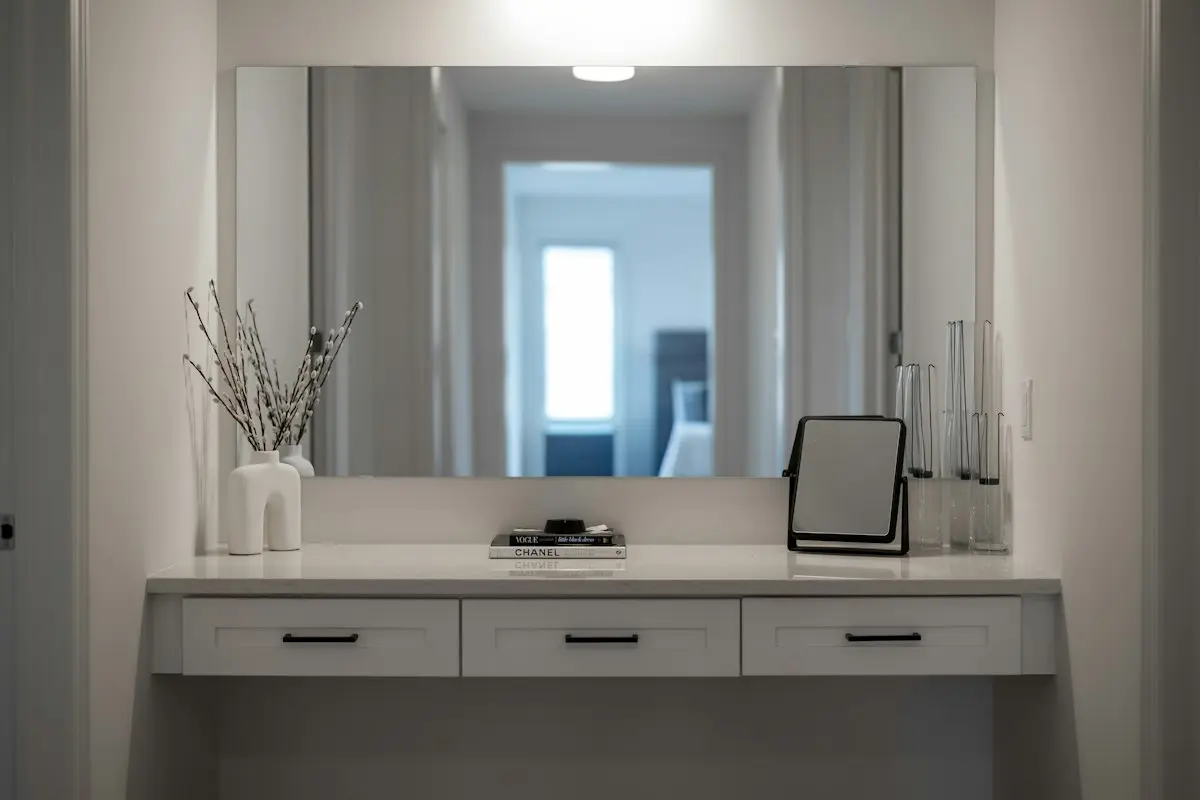
Where mirrors are most often made
- Bathroom. Above a basin, often with cut-outs for a light fitting or with perimeter backlighting. Edge resistance to moisture is part of the job.
- Hallway and dressing room. Tall mirrors, sometimes the full height of the wall or mounted on wardrobe doors.
- Mirror wall. Several panes side by side with a joint. It needs a flat substrate, otherwise the reflection breaks up.
- Non-standard shapes. A circle, a rectangle with cut corners, a cut-out around a switch or a pipe.
Edge: ground or bevelled
A mirror is normally not set in a frame, so the edge is always visible. That makes it a matter of appearance as well as safety.
- Ground and polished edge. A clean, straight side. The most common choice in modern interiors.
- Bevel. A chamfered, ground band around the perimeter that catches the light as a thin line. It makes the mirror read as an object rather than a bare sheet.
Fixing: adhesive or hardware
How the mirror will be fixed has to be decided before it is made, because it determines whether holes will be drilled.
- Bonding to the wall. With an adhesive made for mirrors, usually combined with double-sided tape that holds the pane while the adhesive cures. The substrate must be flat, sound and dry. Ordinary silicones and construction adhesives can damage the backing of the mirror.
- Mirror clips or a hanging system. A removable solution. Useful where the wall may be altered later.
- Through-fixing with screws. The holes are drilled in production, never on site.
Where not to put a mirror
Trouble comes from direct contact between running water and the edge, from an uneven or damp wall, from a freshly built partition that is still moving, and from a position above a permanently warm surface such as a radiator. If in doubt, describe the place in the enquiry. The glazier can usually tell during the survey whether the substrate will take adhesive or whether hardware is needed.
Backlighting and cut-outs
Backlit mirrors are made in two ways: the fitting is mounted above or behind the mirror, or a sandblasted band is created in the mirror coating for light to pass through. Both have to be resolved before production, because each needs either holes for the cable or a surface treatment. In older bathrooms the most common obstacle is that the electrical supply is somewhere other than where the mirror would fit.
What to put in the enquiry
- the dimensions, and whether it is free wall space or an exact gap between furniture,
- whether the mirror is going into a bathroom,
- whether you want a bevel or a ground edge,
- whether it needs cut-outs for a light fitting, a switch or handles,
- the condition of the wall, ideally with a photo,
- whether the firm should fit it as well.
If you are also dealing with a shower screen or a glass splashback, put it in the same enquiry. One survey can cover more than one item; see shower screens.
Frequently asked questions
Can a mirror be bonded onto bathroom tiles?
Normally yes, provided the tiles are sound and flat. An adhesive made for mirrors is used, because ordinary construction adhesive can attack the backing. On freshly tiled or damp walls, bonding is postponed.
Can a hole be drilled in a finished mirror?
In ordinary mirror glass it is theoretically possible, but the risk of cracking is high and it is not done on site. Holes are specified before production.
What is a bevel and when is it worth it?
A bevel is a chamfered, ground band several centimetres wide around the perimeter of the mirror. In daylight it reads as a thin line around the edge. It is worth it on free-hanging mirrors in living areas, where the edge stays visible.
Send us the glass sizes
An e-mail address is enough. Tell us what broke or what you need made, and add the dimensions even if they are only approximate.
- Give the dimensions and where the mirror is going.
- Mention cut-outs for a light fitting or a switch.
- Add a photo of the wall; it helps with the fixing method.